Quality manager
Control plans under control, changes published in a controlled way, a traceable measurement process.
Occama is a quality management system for manufacturers that connects the rules with what actually happens in production. Curator centralises control plans and recipes. Collector guides the operator through measurement by those plans and collects the results.
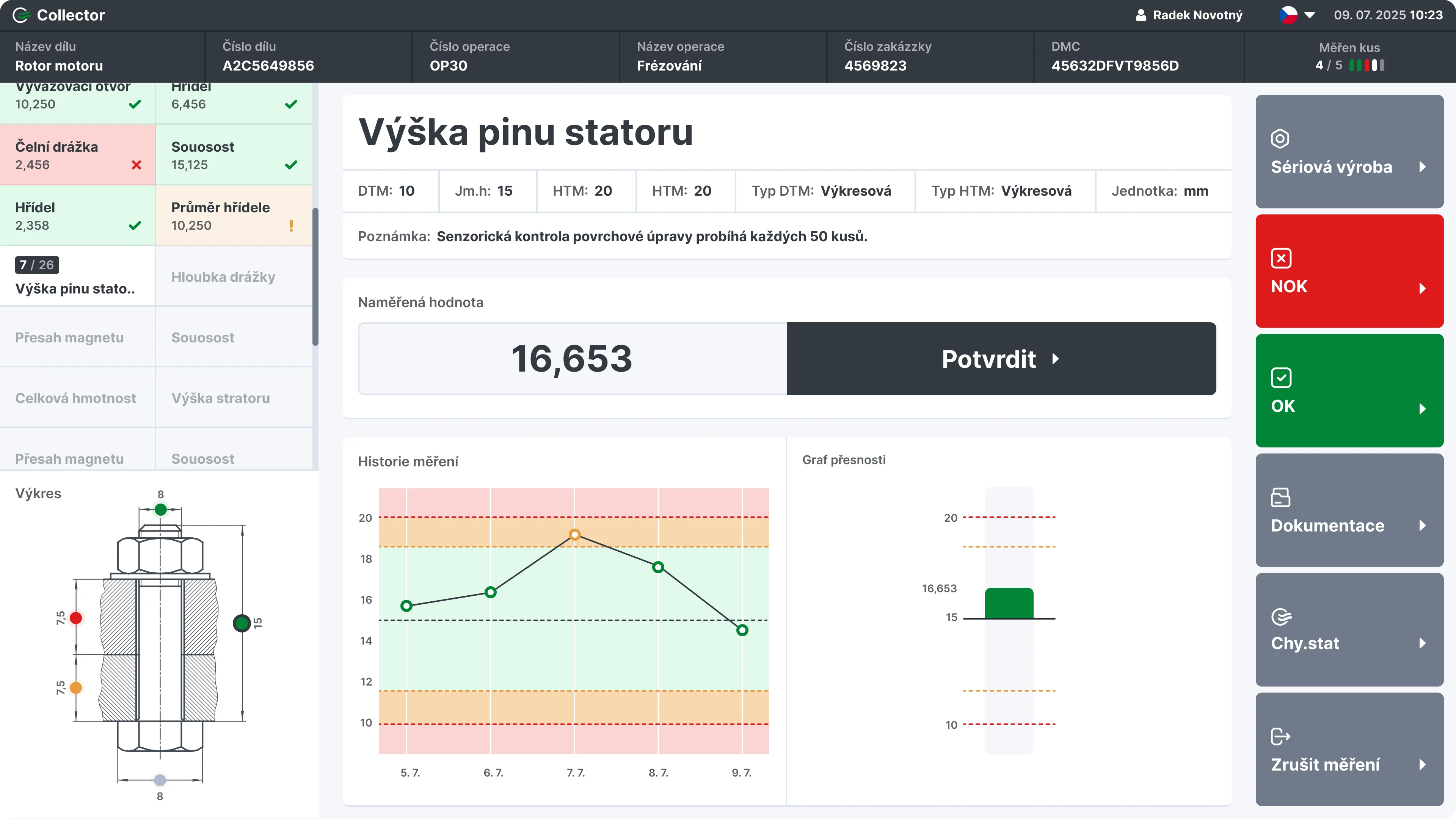






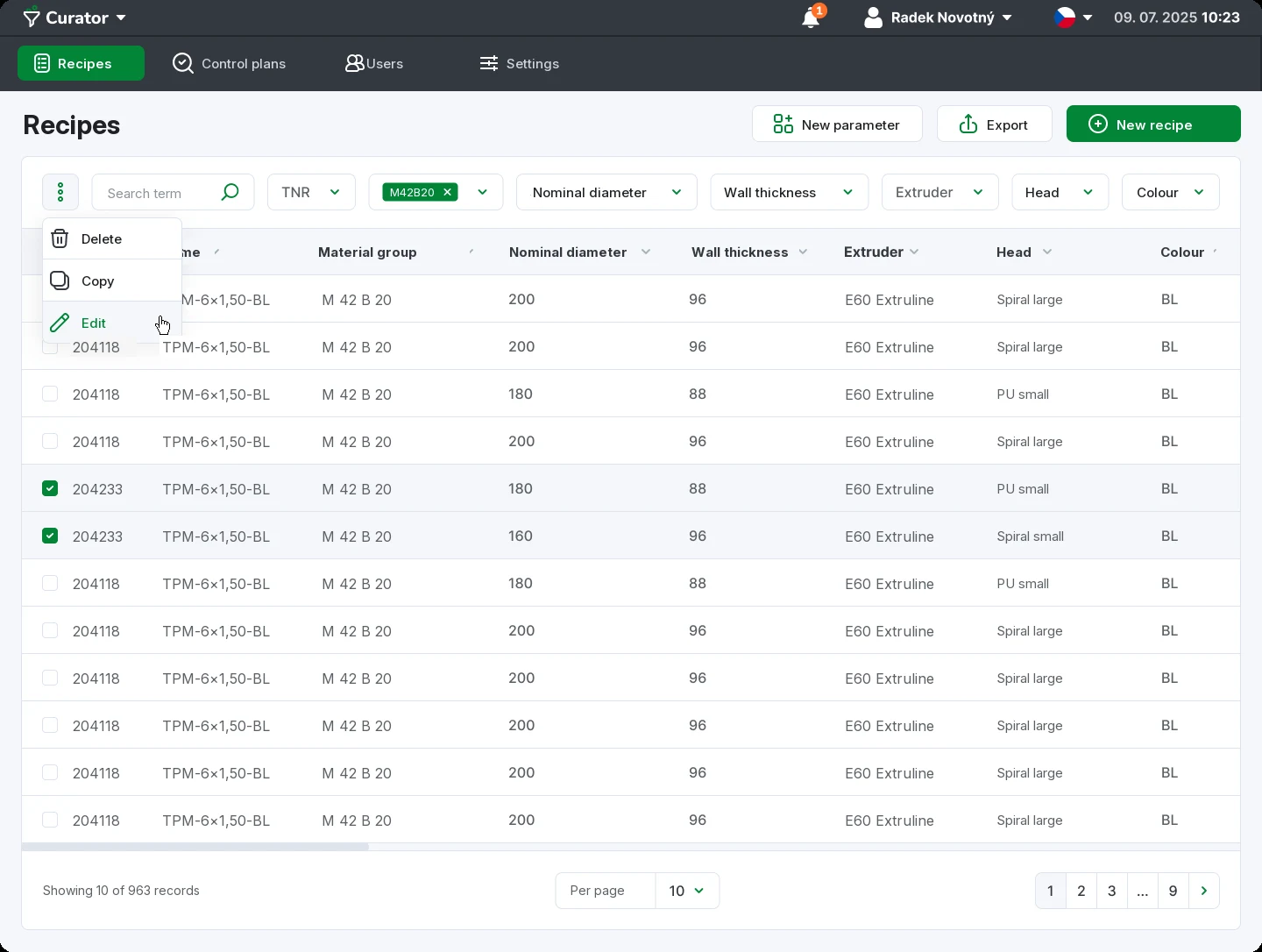
In Curator you model the control plan or recipe: parameters, tolerances, measurement frequency, instruction images.
You release the change to the shop floor in a controlled way. Not by sending out a new file, but by publishing a version.
Collector shows the operator what to measure for the given operation, order or product. And how.
The operator enters the measured value. The system immediately relates it to the defined parameters and tolerances.
Results move on: to your databases, reporting, SPC or higher-level systems.
Curator isn't a control plan editor. It manages everything that governs how your plants produce and measure: control plans, recipes, parameters, catalogues, inspection structure and above all the changes you keep making to them.
Take any Excel file you use today and send it to us. We will send back a short video showing what that same plan looks like in Curator and how an operator would measure by it in Collector.
Send a control planWe ask nothing in return and you don't have to talk to us.
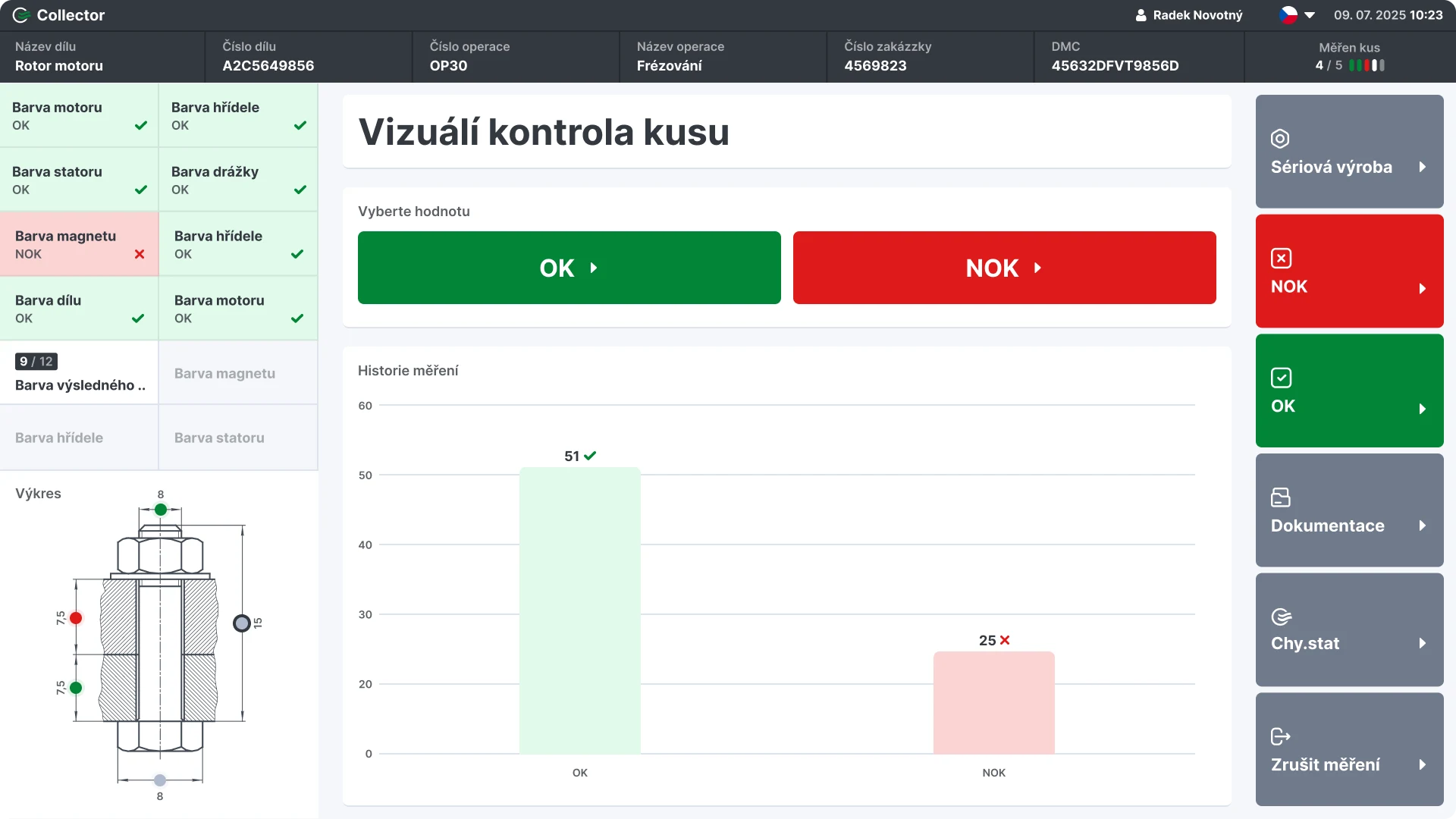
Collector turns the control plan into concrete action. Based on the operation, order or product it shows the operator what to measure and walks them through it step by step.
Collector can be called from the context of a production order or a higher-level application. It doesn't have to be a separate island. It can be a step in your existing workflow.
We don't compare ourselves with specific systems feature by feature. The difference is in the architecture and in how the data is handled day to day.
You do not run quality in isolation. Occama assumes that ERP, MES and other production applications run alongside it and that measurement data has to move on.
Communication with adjacent systems.
Collector can be called from a higher-level application.
Structured for reporting, SPC and further analysis.
Mapping your catalogues to the key numbers you already use in other systems.
Occama connects to your corporate SSO.
Hosted by us or on your own server.
Occama produces clean, structured data that you then work with in SPC and other tools. Cpk and process capability stay where you are used to calculating them.
Occama makes sense in mid-sized and large manufacturers where quality is defined by documented specifications and measured against them. Automotive Tier 2 to Tier 4 is where the benefit is easiest to see. It's not the only place it belongs.
Control plans under control, changes published in a controlled way, a traceable measurement process.
Recipes, process parameters and manufacturing specifications in one structure.
Sees what to measure, with which gauge and to what tolerance. No piecing it together from a drawing, a plan and a report.
The hard part is not deploying the application, it is putting the data in order. What data you have, what it is called, what it means, what the catalogues look like and what exactly counts as a control plan at your company. Thinking the structure through usually takes longer than configuring the system. That is why we deploy Occama together with you.
We don't just deploy software. We help you unify control plans, data and the measurement process so the system actually works.
We show Curator and Collector and ask how you manage control plans today. By the end you know whether it fits your environment, and we give you a ballpark price.
We convert your control plans, configure the system around the way you run quality, and start measuring at the stations. Scope and schedule are already clear from the first meeting.
Occama is licensed by the number of stations where measurements are taken and by the number of plants. The licence includes the first stage of implementation: converting your control plans and configuring the system around the way you run quality.
The price per measuring station is fixed and is not multiplied by how many features you use there. The more stations, the lower the price per station, and beyond a certain scope covering a whole plant becomes a flat fee.
We give you a ballpark figure for your size of operation right in the first meeting, before you have to request anything internally.
We convert them. Whether they sit in Excel or in an older CAQ system, the goal is to get them into one structure that can be managed centrally, including unified naming and catalogues. The conversion is part of the implementation, not work you have to do upfront.
The scope is driven by the state of your data, not by the size of the installation. From you we need access to what you use today (control plans, catalogues, the list of parameters) and one person from quality who decides what the resulting structure should look like. You get the schedule after the first meeting, once we know what we are working with.
Whichever suits you. The features are the same either way. Occama is a web application, so nothing is installed at the stations; Collector runs in a browser on a panel, tablet or PC at the machine. If your internet connection drops, an installation on your own server makes sense, with Collector communicating over your internal network.
For every measurement it records what was measured, against which version of the control plan and with what result, and the data can be exported. That gives the audit a traceable trail from the specification to the measured value. Exactly what form of record your auditor requires is something we go through during deployment.
Collector is designed for the shop floor, not the office: the operator picks a control plan and enters measured values, with no other choices in front of them. Training is therefore short and someone from your own quality team can run it. Measurement masks and control plans are configured by the process engineer in Curator, not by the operator at the machine.
The interface is fully localised into Czech, English and German. The language is set per user, so people can work side by side in different languages within one plant.
Half an hour online. We show Curator and Collector, ask how you manage control plans today, and give you a ballpark price. If it makes sense, we arrange a longer demo for your team.
Pick a time (30 minutes)A calendar opens where you choose a free slot. It takes a minute and there is nothing to fill in.